HANSA SETHI
Hope's Remnant
Hope's Remnant
Couldn't load pickup availability
Hope’s Remnant is not about despair — it’s about the single, stubborn ray of light that refuses to be swallowed by it. It captures that impossible instant when darkness believes it has won, and yet something within it glows anyway — not loudly, not triumphantly, but with quiet conviction. This is hope stripped of idealism, reduced to its rawest form: a pulse that persists even when it has no reason left to.
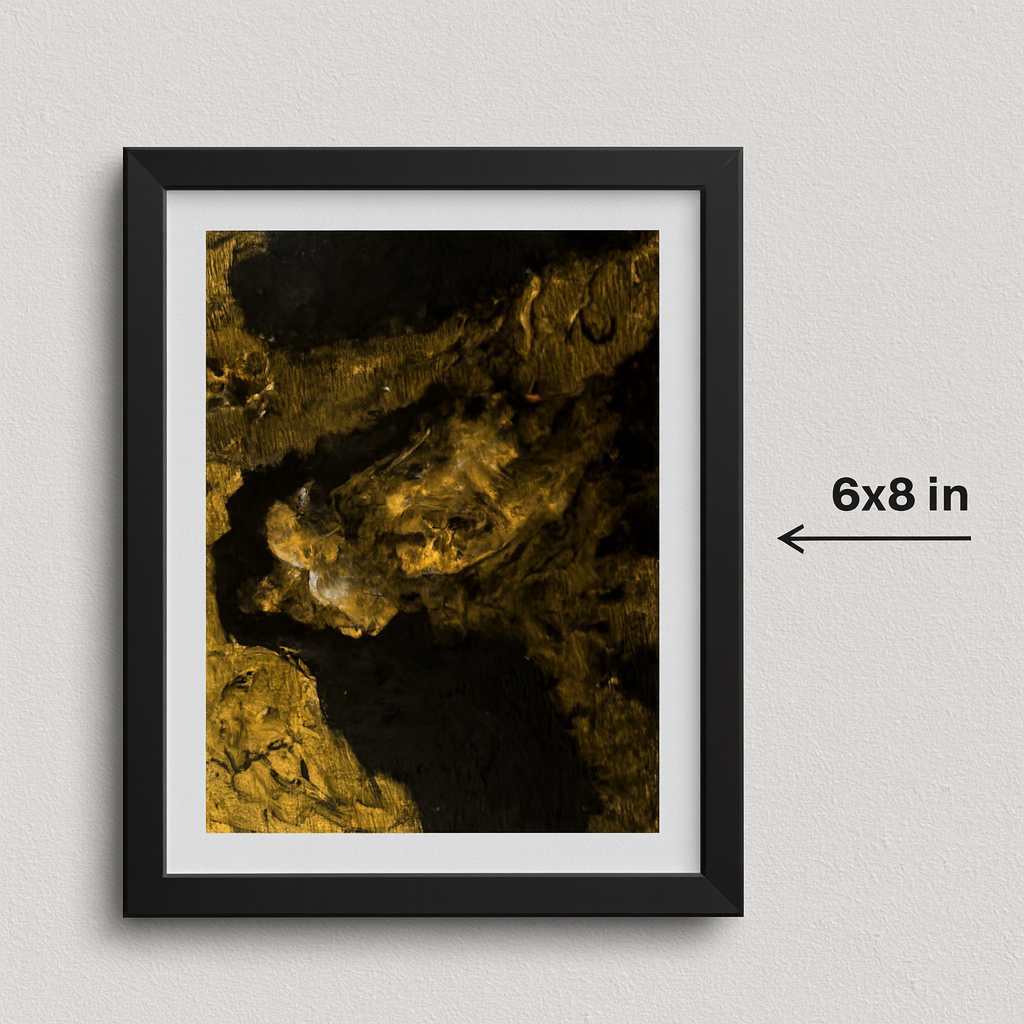
The composition radiates tension between surrender and endurance. The black that dominates the surface feels endless — dense, liquid, almost cosmic in its silence. It absorbs everything, pulling color and light into itself, as if trying to erase memory. And yet, within that depth, gold emerges — uneven, cracked, but unmistakably alive. It cuts through the darkness like a faint beam breaking through a stormcloud — thin, trembling, but relentless.
The texture of the painting mirrors the psychology of survival. The darkness isn’t smooth; it moves, it breathes, it swirls with traces of buried energy. The gold doesn’t lie neatly upon it — it fights its way through, layered and coarse, as though forged from resistance itself. You can sense the friction between the two — the push of despair, the pull of persistence. The gold does not conquer the black; it coexists with it, and that coexistence becomes the act of hope.
This isn’t the kind of hope that promises rescue. It’s the one that exists without promise — the one that lives purely because it refuses not to. There’s beauty in that defiance, a quiet nobility in its fragility. The faint glow of gold against the engulfing black suggests that even in the heart of shadow, the will to rise never fully disappears. It transforms, adapts, hides — but it’s there, breathing beneath the weight.
Each section of this painting feels like a conversation between ruin and resilience. The gold’s irregular shine is memory — what remains of faith after the fire. The black’s viscous calm is acceptance — not defeat, but understanding. The entire work exists in that sacred in-between space: where despair ends and endurance begins.
What gives Hope’s Remnant its gravity isn’t the light itself, but how hard that light has to work to exist. You can almost feel the pressure of its survival, the cost of holding on. The painting becomes a portrait of the human spirit at its most elemental — stripped of drama, stripped of illusion, left with nothing but the instinct to continue.
If you read it closely, you realize the title isn’t melancholy — it’s accurate. A remnant is what survives when everything else is gone. This work celebrates that survival: the last ray that refuses to flicker out, the last belief that won’t stop believing. It’s not grand or loud. It’s small, raw, and infinite.
In essence, Hope’s Remnant is about the endurance of light — not the kind that blinds or conquers, but the kind that quietly endures in the deepest dark. It’s the whisper that says still here, even when the world has already gone silent.